
What IS happening in the Toronto and GTA real estate market?
Sales across the Greater Toronto Area held nearly steady in July 2026 — just under 6,000 transactions, down less than 1% from July 2025. New listings, meanwhile, kept shrinking, falling to just over 14,000 from roughly 17,600 a year earlier, a drop of close to 20%. Prices across all tracked GTA markets were down 4.5% year-over-year. Put together, the region has settled into balanced-market territory overall, though that headline number hides real differences between property types — semi-detached homes and townhouses are still tight and competitive, while most of the condo market leans toward buyers.
By Beril & Sedat Homes | August 7, 2026
If you only read the headlines, July's numbers probably looked confusing. Sales roughly flat, prices down, but some property types selling over asking in under two months of inventory while others sit with a five-month supply. Here's what's actually going on underneath those numbers, and what it means depending on whether you're buying or selling.
Sales Held Steady While New Listings Kept Shrinking
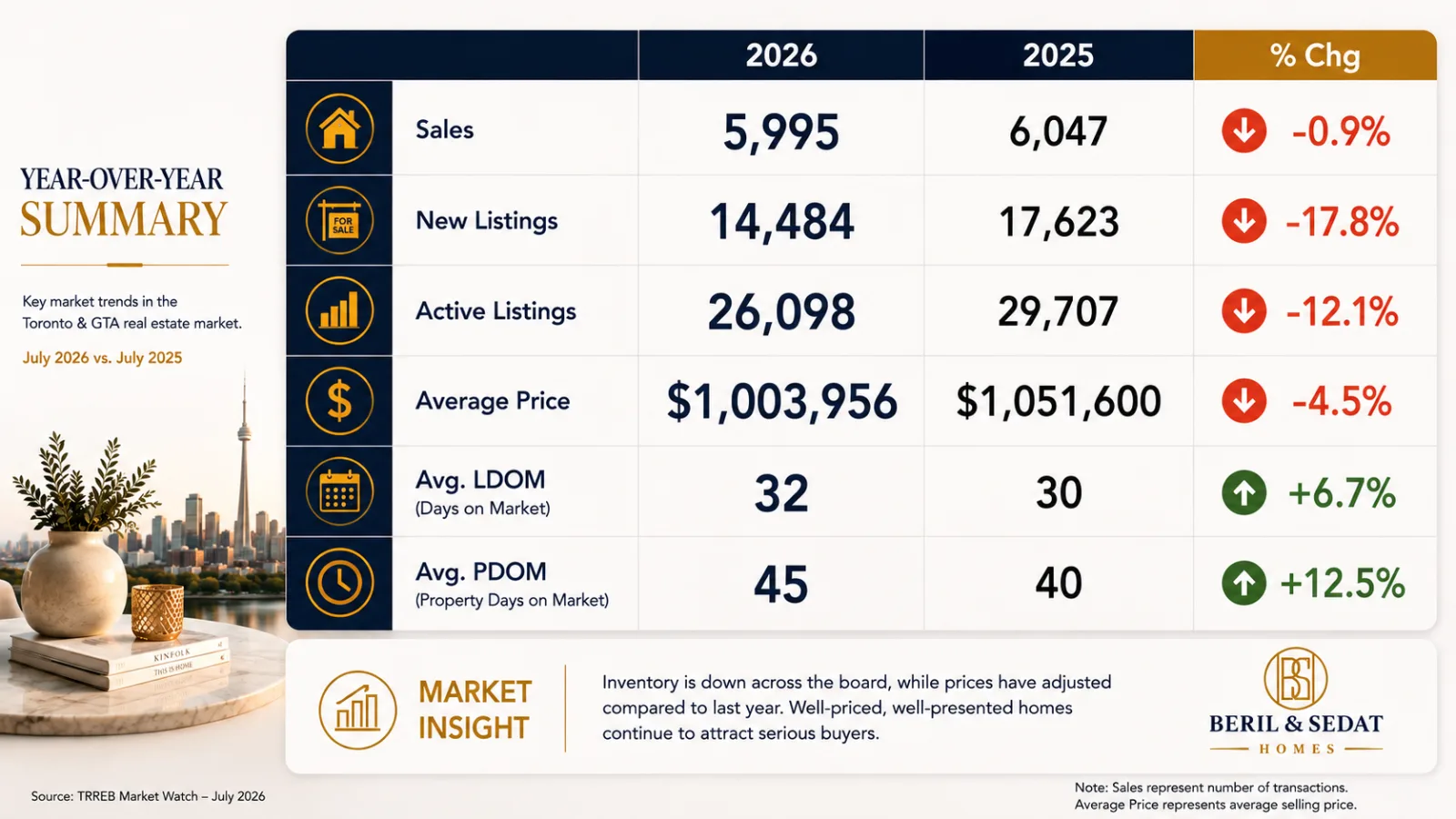
Across the GTA's tracked markets, July 2026 brought in just under 6,000 sales, compared to 6,047 in July 2025 — a difference small enough that it doesn't really signal anything on its own. What's easy to forget is that last July was unusually strong: it was the best month of 2025 up to that point, until October eventually beat it out. So holding nearly flat against an unusually good month is a better result than it first appears.
The more meaningful trend is on the supply side. New listings came in at just over 14,000, down from about 17,600 the year before — a decline of roughly 20%, continuing a pattern that's held for months. Fewer sellers are choosing to list at all right now. Some of that is homeowners who tried and didn't sell simply not relisting; some of it is investment property owners switching to renting instead of selling into a softer market.
That combination — sales holding steady while new supply keeps shrinking — is what's suggested that sales volume has largely bottomed out, even while prices continue to soften.
What's Actually Happening by Property Type in Toronto
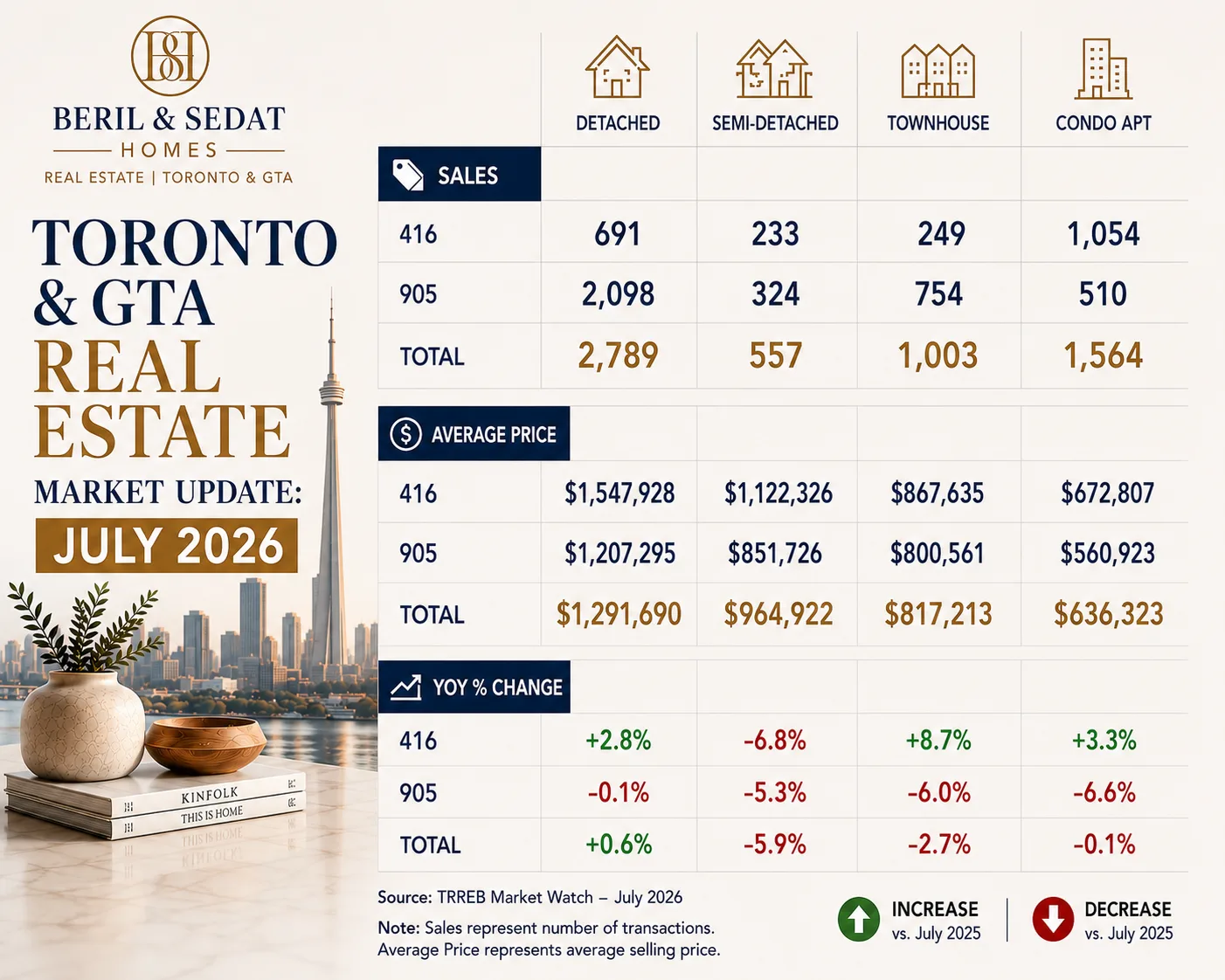
City-wide averages can hide a lot, especially with smaller sample sizes. Here's how each property type in the city of Toronto actually performed in July:
Detached homes: 691 sales against 2,607 active listings — 3.7 months of inventory, which is a genuinely balanced market. Homes that sold went for 97% of asking price on average, in 29 days.
Semi-detached homes: 233 sales against only 459 active listings — under 2 months of inventory. Despite average prices reading down about 10% year-over-year, semis are still arguably the most in-demand property type in the city, selling over asking on average in 24 days. The price figure is skewed by a smaller, more variable pool of sales — the underlying demand hasn't softened the way the average number suggests.
Townhouses (freehold, attached): 95 sales against 225 active listings — 2.3 months of inventory, selling at 100% of list price on average, in 26 days.
Condo townhouses: 154 sales against 727 active listings — 4.7 months of inventory, selling under asking (98% of list) in 35 days on average.
Condo apartments: just over 1,000 sales against 5,228 active listings — about 4.9 months of inventory, or roughly a 20% absorption rate. That's technically the high end of a balanced market, but in practice it behaves like buyer's-market territory for most segments. Homes that sold went for 97% of asking, in 37 days on average.
The takeaway: there is currently no property type in the city of Toronto sitting in clear seller's-market conditions on inventory alone, but semi-detached homes and townhouses are close enough — with under 2.5 months of supply — that well-priced listings are still moving quickly and, in the case of semis, still fetching over-asking offers.
Benchmark Price: The Real Story Behind the Headlines
Average price is easy to report but easy to misread, especially in lower-volume categories where a handful of unusual sales can swing the number. Benchmark price — which tracks a consistent, typical home rather than whatever happened to sell that month — tells a steadier story.
Looking at detached, semi-detached, townhouse, and condo benchmark prices from their market peak to today, all four property types have fallen somewhere between 15% and 25%, depending on the specific property type and area. More recently, prices ticked up in the early part of 2026 before pulling back again from June into July — a seasonal pattern that shows up almost every year, across most property types.
One thing that stands out: condos have been holding up better than expected on benchmark price, even as the segment shows the most inventory and the longest days on market. It echoes a pattern seen in 2023, when prices briefly rose before falling back again. Since around January 2024, though, the broader trend across property types has been a steady, gradual decline.
Are We Close to a Bottom?
It's the question every buyer sitting on the sidelines is asking, and there's no way to call it with certainty until it's already happened. But the signals pointing toward a bottom are becoming clearer.
New listings continue to shrink. Sales volume has been modestly better each month of 2026 than the same month in 2025 — and while 2026 can't be fairly compared to the anomaly that was 2021, it's now running ahead of the last several more typical years. Investors, meanwhile, make up less than 5% of the resale market right now, which is a meaningful shift from prior cycles and part of why overall transaction counts remain lower than a market like 2019, which saw over 3,000 sales in the city in July alone on the back of much heavier investor activity.
For context, July 2026's 2,224 sales in the city of Toronto were higher than July 2025, 2024, 2023, and 2022 — and the best July the city has seen since 2021. In terms of sales volume, it's starting to resemble a 2017-era market more than anything recent, though pricing is still a different conversation entirely.
If current trends hold — shrinking new supply, steadier sales — detached and semi-detached homes look closest to a price bottom, if they haven't already reached one. Smaller, investor-oriented condo units still appear to have further to go in terms of price discovery before that segment stabilizes the same way.
Frequently Asked Questions
Is Toronto in a buyer's market or a seller's market right now?
It depends heavily on property type. Overall, the city is in balanced territory, but semi-detached homes and freehold townhouses — both under 2.5 months of inventory — behave more like a seller's market, while most of the condo segment, sitting closer to 5 months of inventory, leans toward buyers.
Why are semi-detached home prices down if they're still the most in-demand property type?
Average price in a lower-volume category like semi-detached homes can be skewed by a small number of unusual sales in either direction. With under 2 months of inventory and homes still selling over asking, the underlying demand for semis hasn't weakened the way the year-over-year average suggests.
What counts as a "balanced" real estate market?
Generally, somewhere around 3 to 4 months of inventory is considered balanced — enough supply that buyers have options, but not so much that sellers lose negotiating power. Detached homes in Toronto, at 3.7 months, are a close-to-textbook example right now.
Are Toronto home prices expected to keep falling?
Benchmark prices have been declining gradually since around January 2024, and there's no way to call a bottom with certainty until after it's happened. Shrinking new listings and steadily improving sales volume compared to recent years are both signals typically associated with a market approaching a floor — detached and semi-detached homes appear closest to it.
How does the current market compare to a normal, pre-pandemic year?
In terms of sales volume, July 2026 looks more like 2017 than any recent year — stronger than 2022 through 2025, but well short of 2019's investor-driven activity. Pricing is a separate story, since benchmark prices remain 15% to 25% below their peak depending on property type.
Whether you're weighing a purchase while prices are still working their way toward a bottom, or trying to figure out how your specific property type is actually performing behind the average numbers, it helps to look at the data for your exact neighbourhood and price point rather than the citywide headline. We'd be glad to walk through what these numbers mean for your specific situation. And if financing is part of the picture, it helps to know that our team includes an in-house mortgage broker — Sedat Topcu — who can walk you through your options alongside the real estate side of things. It's one less thing to coordinate on your own.
About Beril & Sedat Homes
Beril & Sedat Homes is an award-winning real estate team serving Toronto and the Greater Toronto Area. Founders Beril Topcu and Sedat Topcu are bilingual Turkish- and English-speaking realtors with Royal LePage Signature Realty. With more than 20 years of combined experience, over $100 million in career sales volume, and more than 200 clients served, they help buyers, sellers, investors, and newcomers navigate Toronto and GTA real estate with confidence. Their expertise spans luxury homes, condominiums, detached homes, investment properties, downsizing, upsizing, and first-time home purchases. Recognized as Executive Circle members and ranked among the top 2% of agents, they're known for personalized guidance, strategic negotiation, and in-house mortgage support through Sedat Topcu, a licensed real estate broker and mortgage broker.