
Should I sell my home first, or buy my next one first?
There's no universal right answer — it depends on your equity position, your risk tolerance, and how liquid your specific property type is right now. Selling first gives you a known budget and zero risk of carrying two properties, but usually means renting temporarily or negotiating a long closing or rent-back. Buying first gives you room to find the right home without rushing, but usually requires bridge financing or a HELOC set up in advance, along with real carrying-cost risk if your current home takes longer to sell than expected.
In today's market conditions, as a rule of thumb, it could be more prudent to sell first and then buy, but again it all comes down to your exact circumstances.
By Beril & Sedat Homes | August 29, 2026
This is one of the first questions we work through with almost every client who's moving within Toronto and the GTA rather than buying or selling for the first time. Both paths work. Both have real downsides. The right one depends less on the market in general and more on your specific numbers.
The Case for Selling First
Selling first puts you in control of your budget. You know exactly how much equity you're working with, you're not carrying two mortgages at once, and you can shop with real numbers instead of estimates.
You know your true budget. Once your sale is firm, your down payment and price range are real numbers, not projections.
You avoid carrying two properties. No bridge loan, no double mortgage payments, no financial exposure if your sale takes longer than expected.
You can buy time on the back end. A long closing date, or a rent-back arrangement where you stay in your home after closing as a tenant of the new owner, can give you weeks to find your next place without needing to move twice.
The downside is timing pressure in the other direction. If you sell before you've found your next home, you may need temporary housing, and in a fast-moving segment of the market, you're shopping under a deadline rather than on your own schedule.
The Case for Buying First
Buying first means you're not rushed. You can wait for the right home, negotiate from a position where you're not desperate to close, and avoid the disruption of moving twice.
This tends to make the most sense when you have strong savings or financing, and when your current home is the kind of property that's realistically going to sell quickly at a well-supported price. That second part matters more right now than it has in a while — it's genuinely property-type-specific. Semi-detached homes and freehold townhouses across Toronto are still moving in under 2.5 months of inventory, often over asking, which makes "I'm confident this will sell fast" a reasonable assumption for those property types. Detached homes are more balanced, and condos are taking meaningfully longer, which changes the risk calculation considerably.
The real cost of buying first is what happens if your current home doesn't sell as quickly as planned. Bridge financing and other short-term tools exist specifically to cover that gap, but they come with costs and qualification requirements that are worth understanding before you commit to this path.
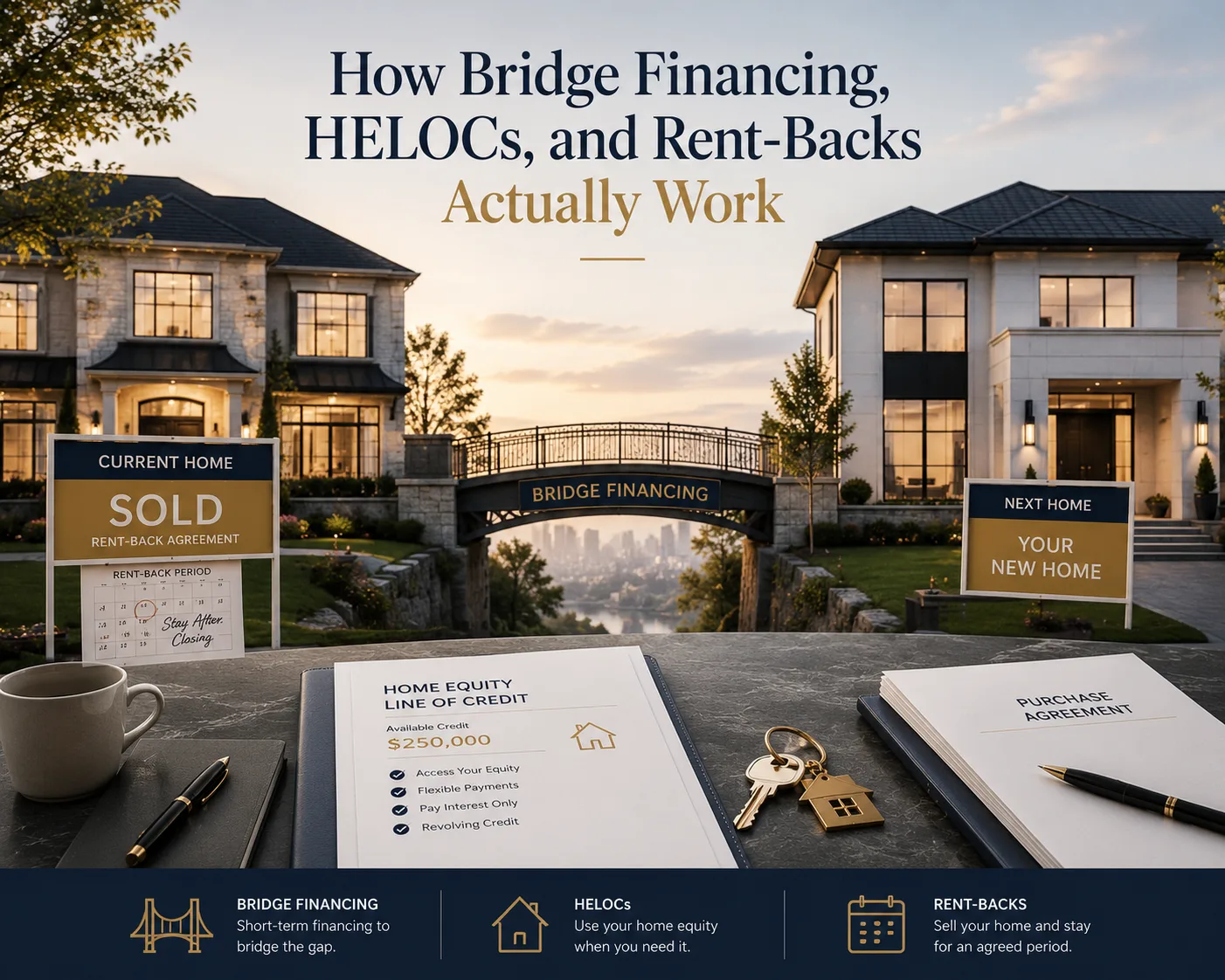
How Bridge Financing, HELOCs, and Rent-Backs Actually Work
There are three main tools people use to manage the gap between buying and selling, and they solve the problem in different ways.
Bridge financing is short-term funding, typically lasting 30 to 180 days, secured against the equity in your current home. If your home is worth $700,000 and you owe $400,000, you may qualify for a bridge loan against a meaningful portion of that $300,000 in equity, minus expected closing costs. Rates run higher than a standard mortgage — generally in the range of prime plus 3% to 4% for variable pricing — and you're typically looking at $1,000 to $2,000 in setup and legal fees on top of the interest itself. A 60-day bridge loan of $150,000, for example, might run somewhere around $3,000 to $3,500 all-in. Critically, most lenders require a firm sale agreement on your current home before they'll approve bridge financing — it's not available just because you expect to sell eventually. Our in house Mortgage Broker - Sedat Topcu - can guide you on that option and make a plan to suit your exact circumstances.
A HELOC (home equity line of credit) is a different tool with a different timing requirement: it generally needs to be set up before you list your current home for sale, not after. Once a property is listed or expected to be listed, many lenders won't restructure or extend new credit against it. Standalone HELOCs are typically capped around 65% of your home's appraised value, or up to 80% when combined with your existing mortgage. If you're even considering buying before selling, this is a conversation worth having with our in-house Mortgage-Broker - Sedat Topcu - well before your home hits the market.
A rent-back agreement (or leaseback) solves the timing problem from the seller's side instead. You sell your home, then rent it back from the new owner for a set period — typically 30 to 90 days, though many arrangements cap closer to 60. It can be a useful alternative to buying first altogether: you get your equity out via a normal sale, and buy yourself time to find your next home without the cost or qualification hurdles of bridge financing. In practice this might be a more difficult arrangement with the new owner mainly due to some legal liabilities.
What Actually Determines the Right Choice for You
A few honest questions tend to settle this faster than any general rule:
Do you have enough equity to qualify for bridge financing if you need it? If not, buying first without a firm safety net is a real risk, not just a preference.
How liquid is your specific property type, in your specific neighbourhood, right now? A semi-detached home in a tight segment is a very different bet than a condo in a segment with several months of inventory.
How much disruption can you tolerate? Selling first sometimes means temporary housing or moving twice. Buying first sometimes means carrying two sets of costs for a stretch. Neither is free — the cost just shows up in a different form.
Do you have a firm sale in hand, or just a plan to sell? Bridge lenders want the former. If you're not there yet, a HELOC set up early or a longer closing negotiated into your eventual sale may fit better than assuming bridge financing will be available when you need it.
None of this replaces running your actual numbers. What you can realistically borrow, what your specific home is likely to sell for in today's market, and which tool — bridge loan, HELOC, or rent-back — actually fits your timeline is worth confirming before you make an offer on anything.
Frequently Asked Questions
What is bridge financing and how much does it cost?
Bridge financing is short-term funding, typically 30 to 180 days, secured against the equity in your current home, used to cover a down payment when your new home closes before your current one sells. Costs generally include interest around prime plus 3% to 4%, plus $1,000 to $2,000 in setup and legal fees — a 60-day, $150,000 bridge loan often runs around $3,000 to $3,500 all-in.
Can I use a HELOC to buy a new home before selling my current one?
Yes, but it needs to be set up before you list your current home for sale — most lenders won't extend or restructure a HELOC once a property is listed or expected to be. Standalone HELOCs are typically capped at around 65% of your home's value, or 80% combined with your existing mortgage.
What is a rent-back or leaseback agreement?
It's an arrangement where you sell your home and then rent it back from the new owner for a set period, typically 30 to 90 days. It lets you access your equity through a normal sale while buying time to find your next home, without the cost or qualification requirements of bridge financing. It is not practiced often in Toronto and GTA markets due to some legal liabilities both parties may risk.
Is it riskier to buy first or sell first in today's market?
It depends heavily on your property type. Semi-detached homes and townhouses are still selling quickly in under 2.5 months of inventory, which makes buying first a more reasonable bet for those property types. Condos are taking longer to sell, which makes buying first riskier without a solid financial backstop in that segment.
Do I need a firm sale agreement to qualify for a bridge loan?
Almost always, yes. Most lenders require a firm, unconditional sale agreement on your current home before approving bridge financing — an expectation that your home will sell isn't enough to qualify.
Whether selling first or buying first makes more sense for you depends on your equity, your specific property type's liquidity, and which financing tool actually fits your timeline. We walk clients through exactly this decision regularly, and we'd be glad to run your numbers before you list or make an offer. Since financing is usually the deciding factor, it helps to know that our team includes an in-house mortgage broker — Sedat Topcu — who can confirm whether bridge financing, a HELOC, or a longer closing fits your situation best.
About Beril & Sedat Homes
Beril & Sedat Homes is an award-winning real estate team serving Toronto and the Greater Toronto Area. Founders Beril Topcu and Sedat Topcu are bilingual Turkish- and English-speaking realtors with Royal LePage Signature Realty. With more than 20 years of combined experience, over $100 million in career sales volume, and more than 200 clients served, they help buyers, sellers, investors, and newcomers navigate Toronto and GTA real estate with confidence. Their expertise spans luxury homes, condominiums, detached homes, investment properties, downsizing, upsizing, and first-time home purchases. Recognized as Executive Circle members and ranked among the top 2% of agents, they're known for personalized guidance, strategic negotiation, and in-house mortgage support through Sedat Topcu, a licensed real estate broker and mortgage broker.