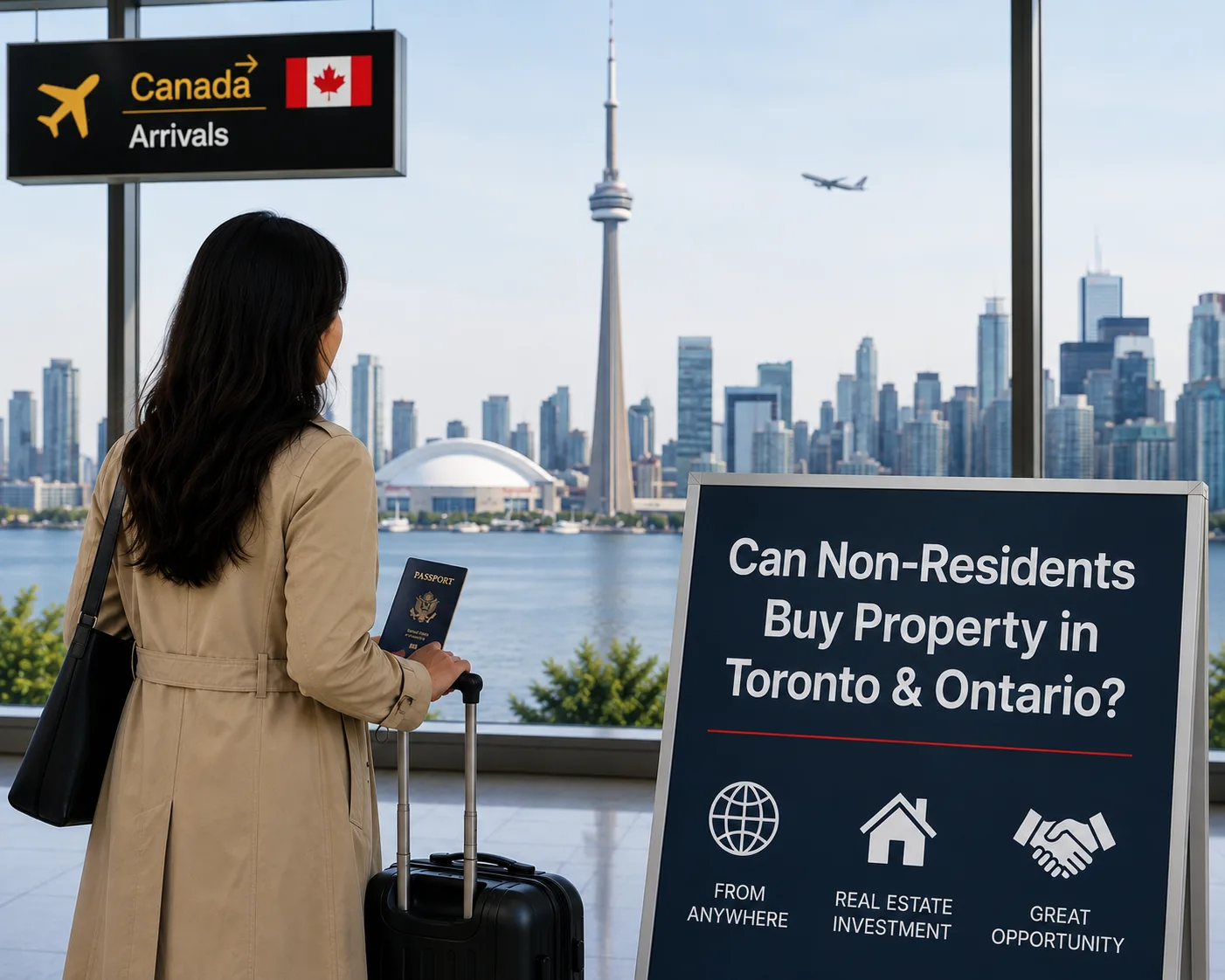
Can non-residents PURCHASE property in Ontario AND IN GTA?
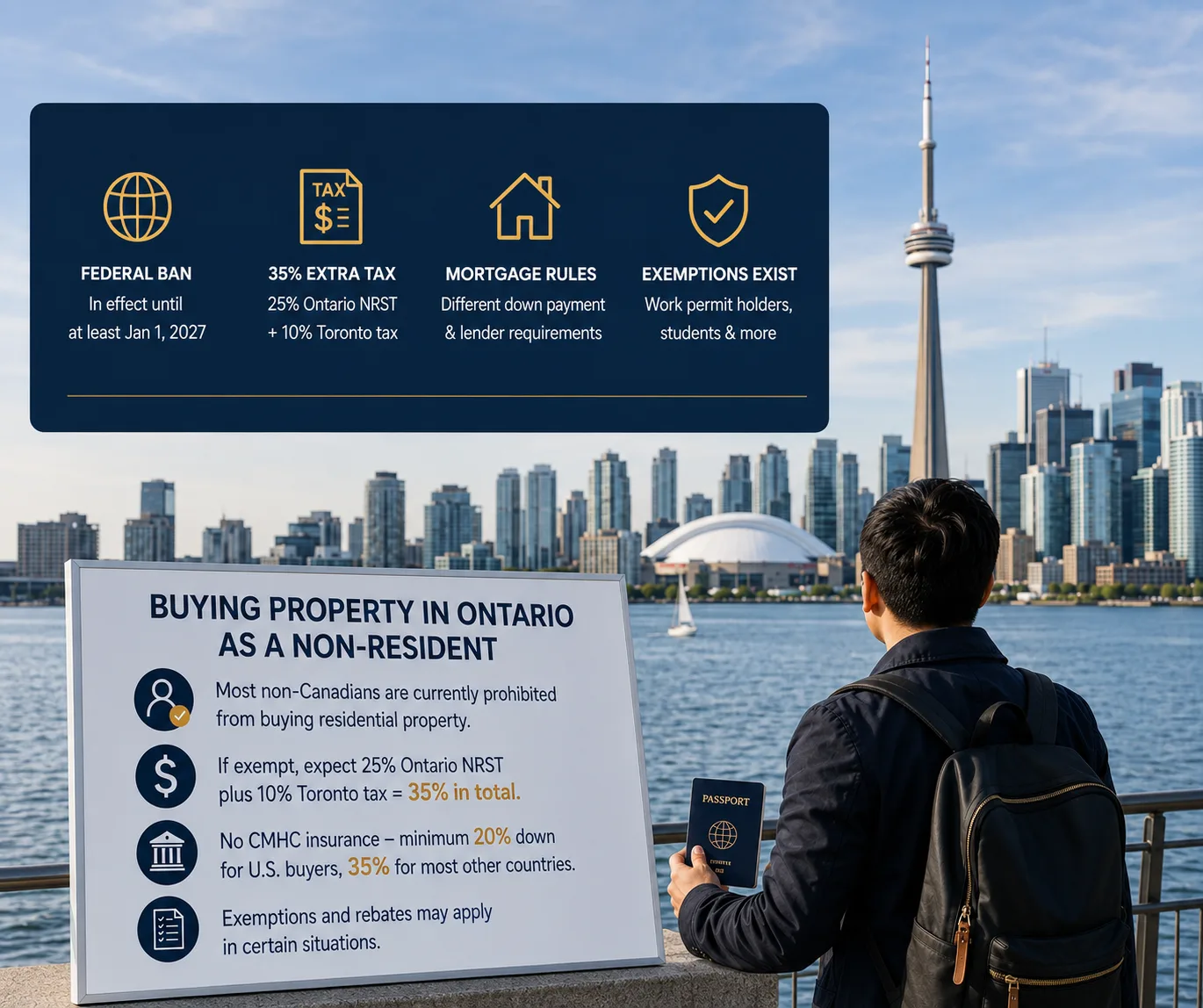
In most cases, no — not right now. Canada's federal foreign buyer ban currently blocks most non-Canadians from purchasing residential property in cities like Toronto, and it's in effect until at least January 1, 2027. Real exemptions exist, though — work permit holders, certain international students, permanent residents, and spouses of eligible buyers can still buy. And even when a purchase is allowed, non-resident buyers typically face Ontario's 25% Non-Resident Speculation Tax plus an additional 10% Toronto-specific tax — a combined 35% on top of standard closing costs — along with different mortgage rules than Canadian residents.
By Beril & Sedat Homes | August 22, 2026
We work with a lot of newcomers and international clients, and this is one of the most misunderstood corners of Ontario real estate. The short version — "non-residents can't buy here" — isn't quite right, and neither is "anyone can buy if they just pay extra tax." Here's how the federal ban, the provincial and municipal taxes, and the financing rules actually fit together.
The Federal Foreign Buyer Ban: Who's Actually Blocked
The Prohibition on the Purchase of Residential Property by Non-Canadians Act took effect January 1, 2023, was extended in 2024, and now runs until at least January 1, 2027. It applies to residential properties with three or fewer units, around Toronto and effectively the entire GTA.
The ban doesn't apply to everyone labelled "non-resident," and it doesn't apply to every property. It's worth checking both sides carefully:
Who's exempt from the ban:
Permanent residents, refugees having protected persons status, and people registered under the Indian Act
Diplomats and their families
Spouses or common-law partners purchasing jointly with an eligible buyer
Work permit holders, provided the permit has at least 183 days of validity remaining at the time of purchase
International students, but only under strict conditions: enrollment at a designated learning institution, five consecutive years of filed Canadian tax returns, at least 244 days of physical presence in Canada in each of those years, and a purchase price capped at $500,000
What's exempt from the ban regardless of buyer status:
Vacant land
Buildings with four or more residential units
Commercial properties
Violating the ban is serious. Penalties run up to $10,000 per violation, for both the non-Canadian buyer and anyone who knowingly helps them complete the purchase. A court can also order the property sold, and the non-Canadian owner is entitled to recover no more than what they originally paid — any appreciation in price is forfeited.
If You're Exempt: Ontario's 25% NRST and Toronto's Extra 10%
Being exempt from the federal ban doesn't mean you're free of extra costs. If you qualify to buy but you're still considered a foreign national, foreign corporation, or taxable trustee under Ontario's rules, the province's Non-Resident Speculation Tax applies: 25% of the purchase price, on top of your standard Land Transfer Tax.
In Toronto specifically, there's a second layer. Since January 1, 2025, the city has applied its own Municipal Non-Resident Speculation Tax of 10%, stacked on top of the provincial NRST. That means a foreign buyer purchasing residential property in Toronto in 2026 is generally looking at a combined 35% foreign buyer tax.
There are exemptions and rebates worth knowing about:
Ontario Immigrant Nominee Program nominees and protected persons or Convention refugees are exempt from NRST entirely.
The Permanent Resident Rebate can return NRST paid if you become a permanent resident within four years of your purchase closing, provided you occupy the property as your principal residence starting within 60 days of closing and continuously afterward. You have 180 days from the date you become a permanent resident to apply.
Financing: How Mortgages Work for Non-Resident Buyers
Even once you've cleared the ban and understand your tax exposure, financing works differently if you're not a Canadian resident.
The biggest structural difference is that CMHC mortgage default insurance isn't available for non-resident purchases. Every non-resident mortgage in Canada is conventional and uninsured which means the buyers needs to put at least 20% down payment:
Buyers from the U.S. can sometimes qualify with as little as 20% down, depending on the lender.
Buyers from most other countries are typically looking at a minimum of 35% down.
If you already own a property in Canada, a subsequent purchase generally requires a minimum 35% down payment as well.
Properties you won't be living in — pure investment purchases — usually sit in the 20–25% range, lender-dependent.
Documentation is heavier too. Lenders generally want verified proof of foreign income, often with certified or notarized translations, and Canadian credit history typically doesn't exist yet, so approval leans more heavily on income verification, assets, and the size of your down payment than it would for a resident borrower. Approval timelines are usually longer, so financing should be arranged well before you're up against a firm closing date.
Not every lender offers non-resident mortgage programs — a few major banks do, alongside a number of specialty and private lenders — so working with someone who knows which lenders are actually active in this space matters as much as the rate itself.
Since financing is usually the piece that determines what's actually possible, it helps to know that our team includes an in-house mortgage broker — Sedat Topcu — who can confirm what you qualify for alongside the real estate side of things.
Putting It Together: What a Non-Resident Purchase in Toronto Actually Looks Like
It helps to see the layers stacked on a real number. Say a work permit holder — exempt from the federal ban, but still a foreign national under Ontario's rules — is buying a $700,000 condo in Toronto:
Non-Resident Speculation Tax (25%): $175,000
Toronto Municipal NRST (10%): $70,000
Combined foreign buyer tax: $245,000
Plus standard Land Transfer Tax and Municipal Land Transfer Tax, calculated on top of that
Minimum down payment, at a typical 35% for a non-resident without other Canadian ties: $245,000.
That's before legal fees, and before factoring in whether a rebate might eventually apply if this buyer becomes a permanent resident within four years and occupies the unit as their principal residence.
None of this means a purchase like this doesn't make sense — for many newcomers building a life in Toronto, it does. But it's exactly the kind of transaction where the ban exemption, the tax exposure, and the mortgage approval all need to be confirmed in the right order, with a real estate lawyer and mortgage broker involved from the start rather than after an offer is already in.
Frequently Asked Questions
Can a work permit holder buy a house in Ontario?
Yes, provided the work permit has at least 183 days of validity remaining at the time of purchase. They're still generally subject to Ontario's 25% Non-Resident Speculation Tax (plus Toronto's additional 10%, if buying in the city) unless another exemption applies.
What is the Non-Resident Speculation Tax and how much is it in Toronto?
It's a provincial tax of 25% of the purchase price, charged to foreign nationals, foreign corporations, and taxable trustees buying residential property in Ontario. In Toronto specifically, an additional 10% Municipal Non-Resident Speculation Tax applies on top of that, for a combined 35%.
Can I get my NRST money back if I become a permanent resident?
Potentially, yes. The Permanent Resident Rebate can return NRST paid if you become a permanent resident within four years of closing, occupy the property as your principal residence starting within 60 days of closing, and apply within 180 days of your permanent residence date.
Can international students buy property in Canada?
Only under narrow conditions: enrollment at a designated learning institution, five consecutive years of filed Canadian tax returns, at least 244 days of physical presence in Canada each of those years, and a purchase price capped at $500,000. That makes it practically not possible for a student to make a purchase in Toronto and GTA.
Do non-residents need a bigger down payment to get a mortgage in Canada?
Yes. Because CMHC mortgage insurance isn't available to non-residents, all non-resident mortgages are conventional, which typically means a minimum down payment of 20% to 35% depending on your citizenship, whether you already own Canadian property, and the specific lender.
Buying as a non-resident isn't impossible in Toronto, but it's a layered process — the federal ban exemption, the provincial and municipal tax exposure, and the financing all have to line up correctly, and the order you tackle them in matters. We work with newcomers and international buyers through exactly this process regularly, and we'd be glad to walk through your specific situation before you make an offer. Since financing is usually the piece that determines what's actually possible, it helps to know that our team includes an in-house mortgage broker — Sedat Topcu — who can confirm what you qualify for alongside the real estate side of things.
About Beril & Sedat Homes
Beril & Sedat Homes is an award-winning real estate team serving Toronto and the Greater Toronto Area. Founders Beril Topcu and Sedat Topcu are bilingual Turkish- and English-speaking realtors with Royal LePage Signature Realty. With more than 20 years of combined experience, over $100 million in career sales volume, and more than 200 clients served, they help buyers, sellers, investors, and newcomers navigate Toronto and GTA real estate with confidence. Their expertise spans luxury homes, condominiums, detached homes, investment properties, downsizing, upsizing, and first-time home purchases. Recognized as Executive Circle members and ranked among the top 2% of agents, they're known for personalized guidance, strategic negotiation, and in-house mortgage support through Sedat Topcu, a licensed real estate broker and mortgage broker.